
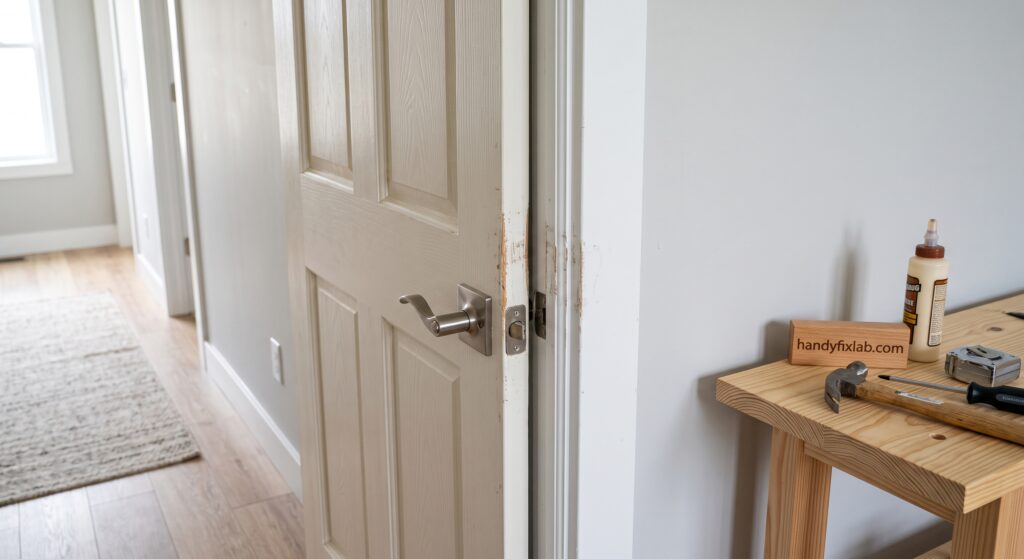
A door that rubs against frame can make opening and closing it frustrating. You may hear scraping, notice worn paint around the edge, or find that the door suddenly feels harder to close.
The good news is that many rubbing doors can be fixed with a few simple adjustments. The cause may be loose hinges, a door that has shifted out of alignment, or wood that has expanded because of moisture.
Before sanding the door, first find exactly where it is rubbing. A door rubs against frame when the door or frame has shifted slightly out of alignment.
1. Door Rubs Against Frame: Find the Rubbing Spot
Close the door slowly and look around the edges.
Check whether the door rubs:
- At the top corner
- Along the latch side
- Near the bottom
- Along the hinge side
- In one small area of the frame
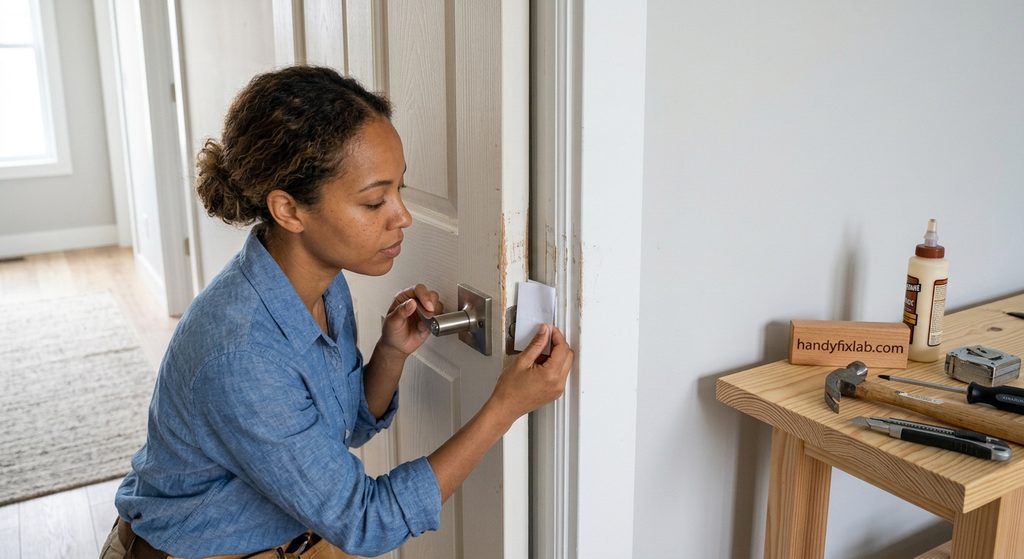
You can also use a piece of paper to check the gap. Slide the paper around the closed door and notice where it becomes difficult to move.
Mark the rubbing area with a pencil. Knowing the exact location will help you choose the right repair.
2. Tighten the Door Hinge Screws
Loose hinge screws are one of the first things to check when a door becomes misaligned.
Open the door and inspect all the hinge screws. Tighten any screws that have become loose, but avoid overtightening them because this can damage the wood.
Pay particular attention to the top hinge if the door appears to have dropped slightly.
After tightening the screws, close the door several times and check whether the rubbing has improved.
Loose hinges can allow a door to shift out of position. For additional guidance, see the HUD guide to adjusting a door.
3. Check the Door Alignment
Look at the gaps between the door and frame when the door is closed.
If the door rubs against frame on one side, check whether the gaps around the door are even.
If the gap is noticeably wider on one side and very narrow on another, the door may have shifted out of alignment.
In some situations, a thin shim behind a hinge can help change the position of the door slightly. A small piece of thin cardboard can work as a temporary shim for minor adjustments.
Make one small adjustment at a time, then test the door again.
Do not force the door or make large changes to the hinges.
4. Check for Moisture or Swollen Wood
If the door started rubbing recently, especially after a period of humid or damp weather, moisture may have caused the wood to expand.
Look for rubbing along a larger section of the door edge rather than just one small point.
If the wood is only slightly swollen, allow it to dry and test the door again before removing any material.
If you sand or plane the door while it is swollen, you could remove more material than necessary after the wood returns to its normal size.
5. Sand the Rubbing Area if Necessary
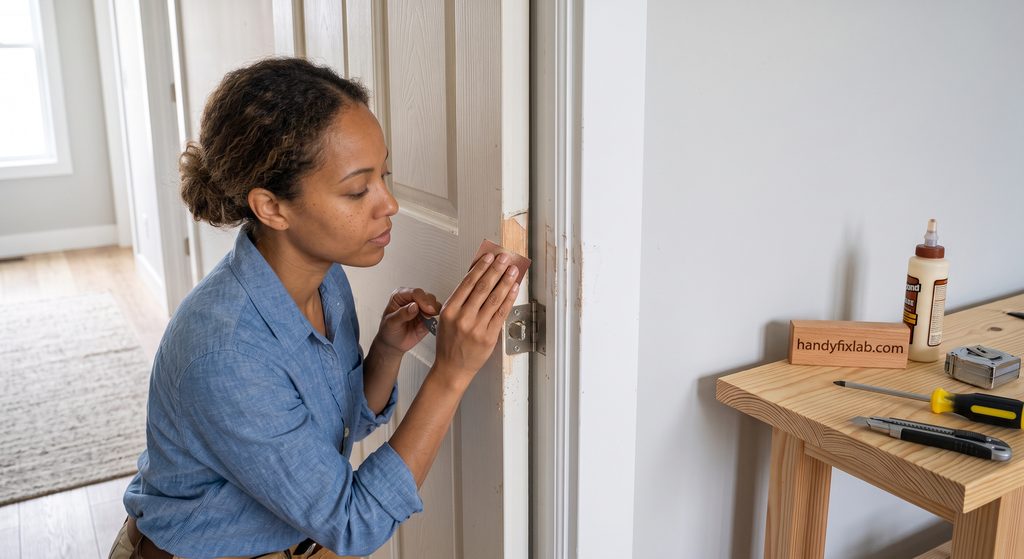
If the hinges are secure and the door is properly aligned but it still rubs, you may need to remove a small amount of material from the affected edge.
Remove the door if necessary and mark the rubbing area clearly.
Use fine-to-medium sandpaper and remove a small amount at a time. Work with the direction of the wood grain and check the fit frequently.
Do not sand a large section of the door without testing it first. The goal is to remove only enough material to stop the rubbing.
After sanding, smooth the area with finer sandpaper.
If the door needs a significant amount of material removed, stop and investigate the cause rather than continuing to sand.
6. Test the Door and Protect the Repaired Area
Open and close the door several times after making the adjustment.
Check that:
- The door opens without scraping
- The door closes normally
- The gaps around the frame look reasonably even
- The latch lines up correctly
- No new rubbing points have appeared
If sanding exposed unfinished wood, protect the repaired area with a suitable primer and paint or finish. Leaving bare wood exposed can allow it to absorb moisture and swell again.
When Should You Call a Professional?
A rubbing door is often a manageable DIY repair, but some problems need more attention.
Consider getting professional help if:
- The door or frame is visibly warped
- The frame has moved or is damaged
- The wood is rotten or badly damaged
- Hinge screws will not hold
- The door requires a large amount of material to be removed
- The door is made from glass or has an automatic mechanism
These problems may indicate that the issue is more than a simple hinge or alignment adjustment.
Final Thoughts
A door that rubs against the frame does not always mean you need to replace the door. Start by finding the exact rubbing point, then check the hinges and alignment before removing any wood.
In many cases, tightening the hinges or making a small adjustment is enough. If the door has swollen or remains tight after alignment, carefully sanding the affected area may solve the problem.
The key is to make small changes and test the door after each one. If your door still has trouble closing completely, see our guide on How to Fix a Door That Won’t Close Properly for another possible solution.
When a door rubs against frame, small adjustments are usually better than removing too much wood. When a door rubs against frame after the hinges have been tightened, check the alignment before sanding the door.